How to Tell If Something Is Antique or Just Old
A lamp from the attic, a chair from a yard sale, a box of your aunt's things. Before you ask what it is worth, it helps to know roughly how old it is. You do not need training for a first pass, just a few places to look.
To tell if something is antique, check the evidence of age rather than the look: how it was made, where it is worn, what marks or labels it carries, what materials and fasteners it uses, and how the surface has aged. The common rule of thumb is that an antique is at least 100 years old. Several clues that agree give you a rough date range; one clue alone does not.
Antique, vintage, retro, collectible
These words get used loosely, especially in listings, where "antique" can sometimes mean "looks old." Here is how they are commonly used. None of them has a single legal definition that everyone follows.
| Word | Rough age | What it usually means | Watch out for |
|---|---|---|---|
| Antique | About 100 years or more | Made a century or more ago. The common rule of thumb among dealers and collectors. | Sellers stretch it. "Antique style" or "antiqued" means made to look old. |
| Vintage | Roughly 20 years or more | Clearly from an earlier era, but not yet antique. Often used for mid-20th-century things. | No agreed cut-off. Usage varies by category and by seller. |
| Retro | Any age | The style of an earlier decade. It can be an original from that decade or a new piece copying it. | "Retro" says nothing reliable about when it was made. |
| Collectible | Any age | Something people collect: toys, advertising, figurines, even recent limited editions. | Collectible describes demand, not age or value. |
Definitions reflect common usage, not a legal standard.
Six quick checks for age
You can do most of these in a few minutes with a phone flashlight. Write down what you find for each one, then see whether the answers point the same way.
1. How it was made
Hand work leaves small irregularities; machines leave sameness. On furniture, pull out a drawer. Machine-cut dovetail joints, all identical and evenly spaced, generally point to the late 1800s or later. Arc-shaped saw marks on the back or underneath come from a circular saw and usually mean mid-1800s or later. Hand-cut joints do not prove age on their own, since some makers still cut them by hand. The antique furniture guide shows what to look for.
2. Where it is worn
A century of use leaves wear where hands, feet and tabletops touch: chair arms, drawer pulls, the foot of a vase, the handle of a spoon. That wear is uneven. Wear that is spread too evenly, or sits where nobody would touch, suggests the piece was made to look old. Our guide to telling if an antique is a reproduction lists more signs.
3. Marks and labels
Turn it over. A maker's name, a country, a pattern name or a registration number can narrow the date a lot. A country name such as "England" usually means made after about 1891, though some pieces were marked earlier and a missing country name does not prove an earlier date. "Made in England" generally points to the 20th century. See how to read pottery marks for the details and the catches.
4. Materials
Some materials rule out great age. Plywood as we know it dates from about the early 1900s and was widely available before 1920, so it usually points to the 20th century, or at least to a later repair. Thin, very even veneer is more typical of Victorian and later work than of earlier hand-cut veneer. Materials that belong to recent decades settle the question quickly.
5. Hardware and fasteners
Look at screws, nails and hinges. Older handmade screws have blunt ends and uneven threads. Pointed machine screws became common from about the mid-1840s–1850s. A Phillips-head screw is never antique. But hardware gets replaced often, so check whether the screw holes look as old as the wood around them.
6. The surface
Old surfaces darken, soften and pick up grime in the corners, a look often called patina. Old shellac and oil finishes tend to wear through; nitrocellulose lacquer, which mostly replaced shellac in the 1920s–30s, tends to chip. Many antiques have been refinished, so a new-looking surface does not rule out age. Whatever you do, do not scrub first. Kovels warns that removing an aged surface can affect both its appearance and its value.
Every check above has exceptions: replaced screws, refinished tops, hand-cut joints on modern pieces. What you want is agreement. If construction, wear, marks and hardware all point to the same period, you can be fairly confident. If they disagree, the piece may be altered, repaired or a later copy.
Four things that fool beginners
- The style. Furniture, lamps and china have copied older styles for well over a century. A piece that looks Georgian or Art Nouveau tells you its style, not its date. Date the construction, not the look.
- The family story. "It was Great-Grandma's" is worth writing down, because provenance matters. But stories shift over generations, and "Grandma's" can mean something she bought in 1965. Let the object confirm the story.
- The dirt. Grime and dust can build up in a few decades in a barn or attic. Heavy dirt makes something look older than it is; it does not add years.
- The listing word. In online listings, "antique" is sometimes a search keyword more than a description. Judge the photos and the evidence, not the title.
Why old does not mean valuable
This is the part that surprises people. Age alone rarely makes something valuable. Kovels puts it plainly: rarity and demand matter more than age alone. Plenty of 100-year-old everyday objects were made in large numbers, and plenty survive, so they sell for modest sums. Meanwhile a mid-century piece by a sought-after designer can sell for far more than a much older one.
It works the other way too. Kovels notes that "an unmarked object isn't necessarily worthless," and a plain, unassuming piece can turn out to be the most interesting thing in the house. That is why it pays to check before you donate, sell or throw anything away.
What tends to move value:
- Condition. Chips, cracks, missing parts and heavy repairs usually cut value sharply.
- Maker. A known maker or designer with a following adds a premium.
- Rarity. Few made, or few survived.
- Demand. What buyers want right now. Collecting tastes change, which is why recent sale prices matter more than old price guides.
- Provenance. A documented history can add interest and value.
What to do next
Once you have a rough age, the order matters. If you check prices before you know what the piece is, you end up comparing it with the wrong things.
Identify it
Work out what it is and roughly when and where it was made, using the checks above, the marks, and a reverse image search if it helps.
Check what similar pieces sold for
Search eBay with the Sold items filter (it shows about the last 90 days), and compare several sales in the same condition. Asking prices are what sellers hope for, not what buyers paid. Our guide to finding what your antique is worth covers other free sources.
Get an appraisal if it might be valuable
If the evidence points to something rare or expensive, or you need a value for insurance or an estate, a qualified appraiser is the right step. See whether you need an appraisal.
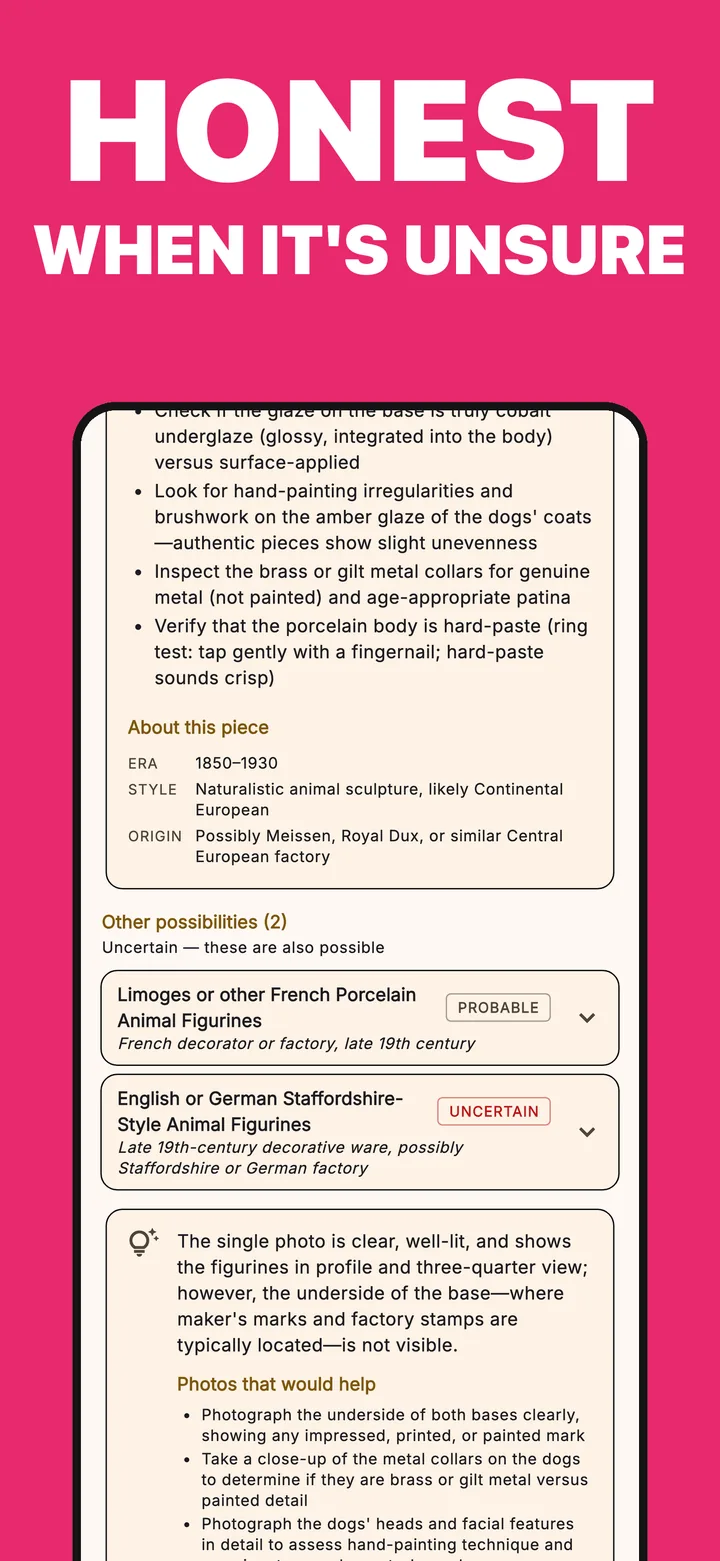
If you are staring at something and have no idea where to start, Vintio, an antique identifier app for iPhone, gives you a first read. Photograph the whole piece, and if you can, the mark underneath and a close-up of wear or construction. It suggests what the piece likely is, a rough era with style and origin, and a confidence level. When it is not sure, it shows other possibilities side by side and tells you which extra photo would help. You also get an estimated value range with the reasons behind it, and a plain note when a piece should go to a professional.
Get Vintio · 3 free identifications to start.
Frequently asked questions
How old does something have to be to be antique?
The common rule of thumb is 100 years or more. Some dealers and marketplaces use the word more loosely, so check the evidence of age rather than relying on the label.
What's the difference between vintage and antique?
Antique usually means about 100 years or older. Vintage is commonly used for things roughly 20 years or older that are clearly from an earlier era but not yet antique. Vintage has no agreed definition, and usage varies by category.
Does antique mean valuable?
No. Many antiques were made in large numbers and sell for modest amounts. Condition, maker, rarity and current demand usually matter more than age. Check what similar pieces actually sold for before assuming anything.
Can I tell age from a photo?
Roughly, yes, if the photos show the right things: the whole piece, the underside or mark, and a close-up of construction or wear. A photo gives you a likely era range, not a firm date. For anything valuable, have it examined in person.
Updated September 25, 2026. Age clues and dates are rules of thumb from dealer, museum and conservation sources; they give ranges, not proof. Vintio gives AI estimates for guidance, not professional appraisals.

Not sure how old it is? Start with a photo.
Vintio gives a rough era, style and origin with a confidence level, shows other possibilities when it is unsure, and tells you which extra photo would settle it.

On a computer?Scan to get it on your iPhone.
Free to download · 3 free identifications · Pro is $4.99/week with a 3-day free trial, or $39.99/year · iPhone, iOS 15+