Clearing a Parent's House: How to Identify What's Valuable
A full house, a deadline, a family group chat, and a lot of feelings. This guide won't make it easy, but it can make it clearer: what to look at twice, where the marks hide, and when to bring in a professional.
To identify valuable items when clearing out a parent's house, don't throw anything out on the first day. Sort into keep, check and let go, and give the "check" pile a closer look: silver, jewelry, watches, signed art, older books and documents, mid-century furniture and lighting, marked pottery and glass, toys, military items and tools. Look for marks on undersides and backs, and compare with sold prices, not asking prices.
Before you start: the first-day rules
The most expensive mistakes in a house clearance happen early, when everyone is tired and a dumpster is sitting in the driveway. A few rules protect you from them:
- Nothing leaves on day one. Not to the dump, not to the charity shop, not to a neighbor who "always liked that lamp." Give yourself one pass through the house before anything goes.
- Check inside things. Pockets, handbags, book pages, envelopes in drawers, boxes in the freezer. Older generations kept cash, jewelry and important papers in unexpected places.
- Keep paperwork together. Receipts, old appraisals, letters and gift cards tell you where things came from. Provenance can matter as much as the object.
- Don't clean or polish yet. An aged surface can matter to value, and tarnish and wear are evidence of age.
- Agree the ground rules with family. Who chooses first, how you'll handle two people wanting the same thing, and whether anything gets sold before everyone has seen it.
A three-pile triage that works
Volume is the real enemy. A method keeps you moving without guessing.
- KeepThings family members want for their own reasons. Note who wants what. Sentimental value counts, and it's often the only kind that matters.
- CheckAnything old, marked, signed, heavy for its size, well made, or that you're simply unsure about. This pile gets photographed and looked up before a decision.
- Let goEveryday items with no marks and no one attached to them: modern kitchenware, linens, mass-produced decor. These go to donation or disposal once the "check" pile is done.
Photograph as you go. Take a whole-piece photo and a photo of any mark, then put a sticky note on the item with a number that matches the photo. When a sibling in another state asks "what was in the hall closet?", you'll have the answer, and you won't have to unpack anything twice.
Where value tends to hide
Most of a house won't be worth much in money terms, and that's normal. But certain categories deserve a second look before they're donated. None of these are guaranteed to be valuable; they're the places worth checking.
| Worth a second look | Where to check | What matters |
|---|---|---|
| Silver (flatware, trays, candlesticks) | Back of handles, underside of pieces | Sterling marks (STERLING, 925) versus plate (EPNS, EP) |
| Jewelry | Clasps, inside ring bands, backs of brooches | Metal marks, maker's marks, stones, signed costume pieces |
| Watches | Dial, case back, inside the case back | Maker, working order, original parts |
| Art and prints | Signature, back of the frame, gallery labels | Original versus reproduction, the artist, condition |
| Books, documents, photos | Title page, first pages, inscriptions | Edition, condition, historical or local interest |
| Mid-century furniture and lighting | Inside drawers, under seats, on the back | Maker's labels or stamps, original finish |
| Pottery, porcelain and glass | Underside or base | Maker's mark, pattern, chips and cracks |
| Toys and collectibles | Base, box, maker's name | Original box, completeness, condition |
| Military items | Backs of medals, insignia, paperwork | Documentation linking items to a person |
| Tools | Blades, handles, maker stamps | Maker, condition, older hand tools |
A guide to where to look, not a list of values. Check each item on its own merits.
Two quick notes. Silver is where people most often throw money away, in both directions: sterling gets donated as "just old spoons," and silver plate gets priced as if it were solid. Our sterling or silver plate guide explains the marks. And inherited dinner china is often the reverse surprise: many sets sell for less than families expect. See is grandma's china worth anything? before you pack it up.
Where to look for marks
Marks, labels and signatures turn "old thing" into something you can look up. They're rarely on the front.
- Undersides of vases, plates, figurines, lamps and chairs.
- Drawer insides and backs of furniture: paper labels, stamps, stencils, and the drawer joints themselves.
- Backs of frames: gallery or framer labels, handwritten notes, stamps.
- Clasps and catches on jewelry and handbags.
- Handles on flatware and serving pieces.
Photograph the mark close up and in daylight, without flash. If it's faint, light it from a low angle so the letters cast small shadows.
How to check a piece quickly
For each item in the "check" pile, you're trying to answer two questions: what is it, and has anything like it sold for real money recently?
- Identify it first. Search the maker's name from the mark plus a short description. Google Lens can find visually similar items, which gives you a name to search, though it won't give you a value.
- Check sold prices, not asking prices. On eBay, turn on the Sold items filter. Normal search shows about the last 90 days. Compare several sales in similar condition, not the single highest one. Our eBay sold prices guide walks through it.
- For finer pieces, check auction results. LiveAuctioneers publishes free price results back to 1999 with a free account.
If a search shows that similar items regularly sell for a meaningful amount, move the piece to its own "get a professional opinion" shelf.
When to call an estate sale company or an appraiser
These are two different jobs, and it helps to know which one you need.
An estate sale company runs the sale: prices the contents, opens the house to buyers, and handles what's left. It makes sense when there's a whole house of ordinary contents and not much time. Ask what they charge, what happens to unsold items, and get it in writing.
An appraiser gives a formal opinion of value, usually in writing. You may want one when:
- you suspect something is genuinely valuable before you sell it,
- the estate needs values for tax purposes or to divide items fairly between heirs (this usually calls for fair market value),
- you're keeping something valuable and want to insure it (insurers use replacement value, which is usually higher).
Look for credentials from the American Society of Appraisers (ASA), the Appraisers Association of America (AAA) or the International Society of Appraisers (ISA), whose members follow the USPAP professional standards. Reputable appraisers charge by the hour or a flat fee, often a few hundred dollars for a written appraisal of a single item. Ask for the fee in writing first.
An appraiser who charges a percentage of what they say the item is worth has a reason to inflate the number. USPAP and the ASA code of ethics prohibit it, and the IRS generally does not accept it for qualified appraisals of donated property. Walk away.
Our guide do you need an antique appraisal? goes into cost and what to bring.
What to do with things nobody wants
Every family ends up with a pile of good things no one has room for. Some options, roughly from most to least effort:
- Offer it around the wider family first. Cousins, grandchildren and old family friends sometimes treasure what siblings don't.
- Consignment shops sell good furniture, decor and clothing and pay you a share when it sells.
- Local auction houses will often take mixed lots, which suits a large volume of mid-value items.
- Donate. Charities, thrift stores, historical societies (for local photos and documents) and schools or theater groups (for vintage clothing) may welcome items. If the estate needs a tax record for a donation, ask about the valuation rules first.
- Keep one small thing each. It's allowed to let the set go and keep the teacup.
How Vintio helps
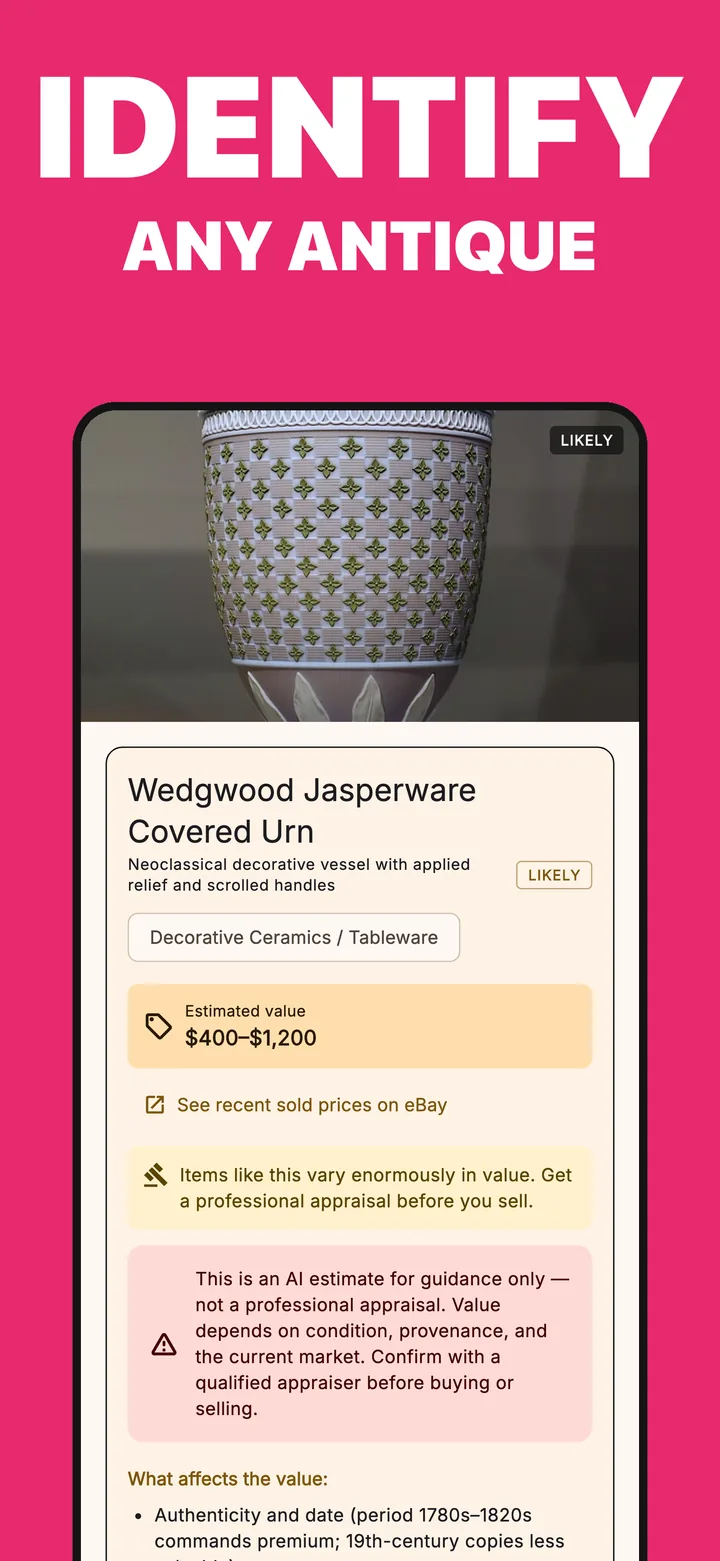
Vintio is an antique identifier app for iPhone that fits the "check" pile. Photograph a piece, its mark and a detail, or pick photos you took earlier from your library. It gives what the piece likely is, a rough era and origin, an estimated value range with the reasons behind it, and how confident it is. When something could be worth real money, it says so plainly and suggests a professional appraisal before you sell. Your finds stay saved on your device, so you can look over the day's pile that evening.
It's an AI estimate for guidance, not a professional appraisal, and there's no account needed to start. Get Vintio on the App Store.
Frequently asked questions
What items in an old house are worth money?
The categories most worth a second look are sterling silver, jewelry, watches, signed art, older books and documents, mid-century furniture and lighting, marked pottery and glass, toys with original boxes, military items and older tools. None are guaranteed to be valuable; check marks and recent sold prices for each piece.
What should I not throw away when clearing a house?
Don't throw out anything on the first day. Keep paperwork, photos and letters until someone has looked through them, check pockets, books and drawers for cash or jewelry, and set aside anything with a maker's mark, signature or silver mark until you've looked it up.
Should I get everything appraised?
Usually not. Appraisals cost money, often a few hundred dollars for a written appraisal of one item, so they make sense for pieces you suspect are valuable, for estate or tax needs, or for insurance. For everyday contents, sold-price research is usually enough.
What do I do with antiques nobody wants?
Offer them to the wider family first, then consider consignment shops, local auction houses or an estate sale. Charities, thrift stores and local historical societies may take what doesn't sell. Keeping one small piece each is a good compromise.
Should I hire an estate sale company?
It can make sense when there's a whole house of contents and limited time. Get the terms in writing, including what they charge and what happens to unsold items. Pull out anything you suspect is valuable first and have it checked separately.
Updated September 25, 2026. Appraisal guidance reflects USPAP, the American Society of Appraisers and IRS Publication 561. Vintio gives AI estimates for guidance, not professional appraisals.

Check the "maybe" pile before it goes.
Photograph a piece and its mark. Vintio shows what it likely is, an estimated range with its reasons, and tells you plainly when to get a professional.

On a computer?Scan to get it on your iPhone.
Free to download · 3 free identifications · Pro is $4.99/week with a 3-day free trial, or $39.99/year · iPhone, iOS 15+