How to Find Out What Your Antique Is Worth, for Free
You have one piece and one question. You don't need a subscription or an appointment to get a sensible first answer. You need the right order of steps, and the honesty to treat the answer as a range.
To find the value of antiques for free, first identify the piece, then look up what similar pieces actually sold for, not what sellers are asking. eBay's Sold filter, LiveAuctioneers' price results and Invaluable's last 12 months of results are all free. Adjust for your piece's condition, completeness and maker. If the answer might run into real money, pay for a professional appraisal before you sell.
The free process, in four steps
Most people start with step two: they search a vague description and land on whatever price appears first. The order below is takes a little longer and is much more reliable.
- Identify what it isYou can't price "an old vase". You can price "a Royal Worcester vase, around 1900, with a crack". Look for a maker's mark on the base or back, look at how the piece was made, and run a photo through Google Lens to find look-alikes and names to search. Photograph the whole piece, the mark and any damage first, in good daylight.
- Find sold prices, not asking pricesSearch the maker and pattern on eBay with the Sold items filter on, which shows about the last 90 days. For auction results, LiveAuctioneers' price results are free with a free account, and Invaluable shows about the last 12 months free. WorthPoint and the Kovels price guide cover more, but they are paid.
- Adjust for your pieceCompare yours with sold examples honestly. Condition, completeness, the exact maker and version, any documented history and current demand all move the number. Look at the middle of several sales, not the single best one.
- Decide whether it needs a professionalIf your research points to a valuable piece, or you need a value for insurance, taxes or an estate, a professional appraisal is worth its fee. For modest pieces, your sold-price research is usually enough.
Each step has its own guide if you want the details:
- Step 1: Is it antique or just old? covers age clues. Pottery marks on the bottom and sterling or silver plate? cover the two most common kinds of marks, and is your furniture antique? covers joints, saw marks and screws. Google Lens for antiques explains what a Lens search can and can't tell you, and how to photograph antiques covers the photos that make every other method work.
- Step 2: How to check eBay sold prices, including the Best Offer catch.
- Step 3: Antique or reproduction? Because a copy of a valuable piece is not a valuable piece.
- Step 4: Do you need an antique appraisal? covers when it pays, what it costs and how to spot a bad appraiser.
What makes an antique valuable
Age alone is rarely what makes something valuable. Kovels, the long-running price guide, makes the same point: rarity and demand matter more than age. These are the factors that usually move the price, and they are the same ones worth writing down when you compare your piece with a sold listing.
- Condition. Chips, cracks, repairs, missing gilding, replaced hardware. A repaired piece often sells for less than an untouched one. Don't clean or polish before an expert has looked: removing an aged surface can affect the value.
- Maker. A known maker, pattern or designer can multiply the price of an otherwise similar piece. That's why step one matters.
- Provenance. A documented history (an old receipt, a label, a photograph of it in the family home) can add value. A family story helps too, but buyers pay most for proof.
- Completeness. The lid on the teapot, all twelve place settings, the original box. Sets are often worth more than their pieces sold separately.
- Demand. Tastes change, and some categories that once sold easily sell for less today. Kovels notes that recent sales are generally more useful than old prices, because collecting markets change.
If you've inherited more than one piece, the same factors apply across the board. Our guides to clearing a parent's house and whether grandma's china is worth anything show how to sort a houseful quickly.
Free and paid places to find sold prices
| Source | Cost | What you get |
|---|---|---|
| eBay, Sold items filter | Free | What buyers actually paid, about the last 90 days |
| eBay Product Research (formerly Terapeak) | Free for sellers | About 3 years of eBay sales, in Seller Hub |
| LiveAuctioneers price results | Free, with a free account | Auction results from thousands of auction houses, back to 1999 |
| Invaluable price archive | Free for about 12 months; paid for older | Traditional antiques and art auction results |
| WorthPoint | Paid subscription | A large database of past sale results, plus a marks library |
| Kovels price guide and Marks Guide | Paid (free weekly newsletter) | Price guide and a marks reference |
Costs and coverage as described by each service, checked September 25, 2026. They change, so check before you sign up for anything.
A word on auction results: a "hammer price" may or may not include the buyer's premium, and a result from a big-city specialist sale won't always carry over to a local one. Unsold lots show up in results too, so check that a piece actually sold.
Why asking prices and single numbers mislead
The most common mistake is anchoring on a number that was never a real sale. An eBay listing at $900 tells you what one seller hopes for. It may sit unsold for a year. The same goes for antique-shop tags and online "values" with no source.
Single numbers are the second trap. Even genuine sold prices for the "same" item spread widely, because condition, size, color and timing differ. Some sold prices aren't what they seem: when a seller accepts a Best Offer on eBay, the price shown can be higher than what the buyer actually paid. So a fair answer to "what's it worth?" is nearly always a range, with reasons for where your piece sits in it.
Is there a free antique appraisal online?
Honestly, not in the proper sense. A professional appraisal is a formal opinion from a qualified appraiser, for a stated purpose such as insurance or an estate, and appraisers charge for it. Free online options give you estimates, which are useful but different.
- Auction houses. Some auction houses accept photos online and reply with a free estimate. That's an auction estimate from someone who would like to sell the piece for you, not an independent appraisal.
- Antiques Roadshow. The PBS show's events are free, but tickets are awarded by sweepstakes, and the appraisers give verbal estimates only, with no written appraisals. They don't value items from photos sent by mail or email. The 2026 tour visited Tucson, Indianapolis and Mumford, New York, and ended in June.
- Forums and collector groups. Often generous and knowledgeable, but the answers vary with who happens to reply.
- Identifier apps. Several apps, including ours, give an estimate from photos. None of them is an appraisal, whatever word the store listing uses. Our comparison of antique identifier apps shows what each one gives you for value.
When you do need a professional, a written appraisal of one item often costs a few hundred dollars. Ask for the fee in writing first. An appraiser who wants a percentage of the item's value is a red flag: USPAP, the US professional appraisal standard, forbids it.
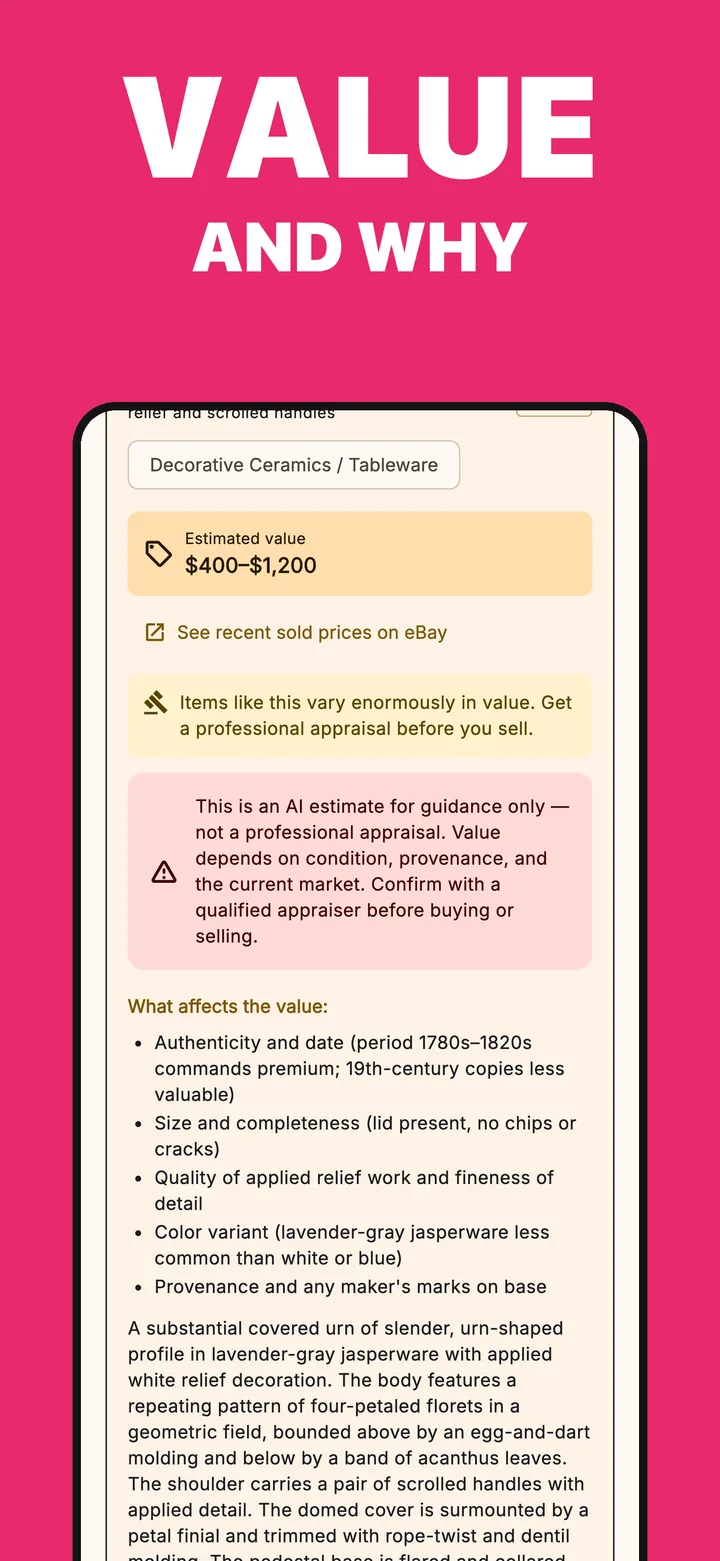
Vintio is one of the free-to-start ways to do steps one to three from your phone. It's an antique identifier app for iPhone, and your first 3 identifications are free. Photograph the whole piece, the maker's mark and a detail, add a note about where it came from, and you get what it likely is, a rough era, style and origin, and an estimated value range. The range comes with the factors that move it: condition, maker, provenance, completeness and demand.
A "See recent sold prices on eBay" link opens a ready-made sold-listings search, so you can check the range against real sales. When a piece could be valuable, Vintio says plainly that it's time for a professional appraisal before you sell. It's an estimate, and it says so. Get Vintio on the App Store.
Frequently asked questions
How can I find out what my antique is worth for free?
Identify the piece first, using its marks, how it was made, and a Google Lens search for names to follow. Then look up sold prices, not asking prices: eBay's Sold items filter, LiveAuctioneers' price results and Invaluable's last 12 months are free. Compare several sales of pieces in similar condition and treat the result as a range.
Where can I get a free antique appraisal?
A true appraisal from a qualified appraiser isn't usually free. Free options give estimates instead: some auction houses give free auction estimates from photos, Antiques Roadshow gives verbal estimates at ticketed events, and apps give AI estimates. For insurance, taxes, an estate or a valuable sale, pay for a written appraisal.
What makes an antique valuable?
Mainly condition, maker, provenance, completeness and demand. Age helps, but rarity and demand usually matter more. A perfect, complete piece by a known maker with a documented history, in a category people are buying today, sells for the most.
Are antique identifier apps accurate?
They give estimates, not appraisals, and the result depends heavily on your photos, especially of the maker's mark. Treat an app's answer as a starting point. Check it against recent sold prices, and for anything that might be valuable, get a professional appraisal before you sell.
Updated September 25, 2026. Price-source details come from eBay, LiveAuctioneers, Invaluable, Kovels and PBS as of that date. Vintio gives AI estimates for guidance, not professional appraisals.

One piece, one question, a straight answer.
Photograph it and get a likely identification, an estimated value range with the factors that move it, and a plain word when it's time for a professional.

On a computer?Scan to get it on your iPhone.
Free to download · 3 free identifications · Pro is $4.99/week with a 3-day free trial, or $39.99/year · iPhone, iOS 15+