When do you need an antique appraisal? Less often than you'd think
Most old things never need one. A few situations always do. This guide explains the difference between an estimate and an appraisal, what a real one costs, and how to tell a good appraiser from a bad deal.
You need an antique appraisal when someone else needs a written value you can defend: an insurer scheduling a valuable item, an estate being settled or divided, a charitable donation, a legal dispute, or a sale where the piece may be worth a lot. For low-value items or plain curiosity, a free estimate is usually enough, and the appraisal fee can cost more than the item is worth.
When you need one, and when you don't
Here is the honest version. Most things in most houses do not need a professional appraisal. A few situations do, and in those, nothing else will do the job.
Get an appraisal when
- You want to insure a valuable piece on its own, and the insurer asks for a documented value.
- An estate is being settled, or heirs are dividing valuable items and want a fair, documented split.
- You plan to donate an item to charity and take a tax deduction for it.
- There is a dispute about what something is worth.
- You think a piece may be valuable and you are about to sell it.
You can probably skip it when
- The item is ordinary, and similar ones sell for less than an appraisal would cost.
- You are just curious what grandma's vase is.
- You are sorting a house and deciding what to keep, sell or donate. Estimates are enough for a first pass.
- You are selling through an auction house, which will give its own estimate for the sale.
The last point in the first list is the one people get wrong in both directions. They pay to appraise a box of everyday dishes, or they sell a good piece cheaply because they never checked. A free estimate first tells you which situation you are in.
An estimate is not an appraisal
The two words get used as if they meant the same thing. They do not.
An estimate is an informed guess at what something might sell for. Sold prices on eBay are an estimate. So is a result from Google Lens, an antiques app, or a friendly dealer. An auction house's free estimate is one too, and remember who it comes from: a business that would like to sell the item for you. That does not make it wrong, but it is not an independent opinion.
An appraisal is a written report by a qualified appraiser. It states what the appraisal is for, the type of value, how the appraiser reached it, and who is responsible for it. That is what insurers, estate lawyers and the IRS are looking for. The IRS, for example, asks for a "qualified appraisal" for certain donations of property, with rules that include how the appraiser may be paid.
Which value do you need?
One object can have several correct values. The purpose decides which one the appraiser gives you, so tell them the purpose up front.
- Fair market value is, in the IRS's words, the price at which property would change hands between a willing buyer and a willing seller, neither being forced to act and both knowing the relevant facts. It is used for tax, donations, estates and sales.
- Replacement value is what it would cost to buy a similar item within a reasonable time, usually at retail. It is used for insurance, and it is usually higher than fair market value.
| Your need | Type of value | Who to ask |
|---|---|---|
| Insuring a valuable item | Replacement value | An accredited personal property appraiser (ASA, AAA or ISA) |
| Settling or dividing an estate | Fair market value | An accredited appraiser; ask the estate's lawyer what the paperwork needs |
| Donating to charity for a tax deduction | Fair market value | A qualified appraiser paid a flat or hourly fee, never a percentage |
| A dispute over value | Depends on the purpose; ask your lawyer | An accredited appraiser whose report follows USPAP |
| Selling something that may be valuable | Fair market value, or an auction estimate | A specialist auction house, plus an independent appraiser if a lot is at stake |
| Curiosity | A rough estimate | Sold prices, a free auction estimate, or an app |
Who to hire
Anyone can call themselves an appraiser, so look for membership of a professional body. In the US, the three main associations for personal property are the American Society of Appraisers (ASA), the Appraisers Association of America (AAA) and the International Society of Appraisers (ISA). The insurer Chubb notes that their members complete coursework, pass exams, show experience and follow USPAP.
USPAP is the Uniform Standards of Professional Appraisal Practice, set by The Appraisal Foundation. It covers personal property as well as real estate. The current edition is the 2024 edition, in force since January 1, 2024.
Also ask about specialty. Someone who knows silver may not know Chinese porcelain or American furniture. A good appraiser will tell you when an object is outside their field.
What it costs, and the fee to walk away from
Reputable appraisers charge by the hour or a flat fee per item. For a written appraisal of one item, expect it to cost often a few hundred dollars. As one example, an ISA-certified appraiser publishes generalist rates of about $100 to $250 an hour, specialists up to about $500, and formal single-item reports from about $250 to $350, plus a smaller charge for each extra item. That is one firm's published pricing, not a survey, so get the fee in writing before you agree.
If an appraiser wants a percentage of what they say the item is worth, walk away. It gives them a reason to push the number up or down. USPAP's ethics rule forbids it, the ASA code of ethics bans it, and the IRS generally will not accept a donation appraisal paid that way.
Free options, and their limits
Free help exists. It is useful for the "should I bother?" question, and it is not an appraisal.
- Auction houses. Many, such as Heritage, Freeman's and Bonhams, accept photos online and give a free auction estimate. It is a useful starting point, from someone who hopes to sell the item.
- Antiques Roadshow. Admission is free, but tickets are won in a sweepstakes, with up to two items per ticket. The appraisals are verbal approximations of value only, with nothing in writing, and the show does not value items from photos sent by mail or email. The 2026 tour visited Tucson, Indianapolis and Mumford, New York, and ended in June.
- Sold prices. What similar pieces actually sold for is the best free reality check. Our guide to checking eBay sold prices walks through it.
What to bring
A prepared visit is a shorter visit, and on hourly rates that saves money. Bring or send:
- Clear photos: the whole piece, the back, the underside and any mark close up, damage, and something for scale. Our photo guide shows how.
- Provenance: where it came from, who owned it, letters, old photos with the piece in them, the family story.
- Receipts and old appraisals, even decades-old ones.
- Marks and measurements, written down.
- The purpose: insurance, estate, donation or sale.
And do not clean or polish it first. Kovels warns that removing an aged surface can affect a piece's appearance and potentially its value.
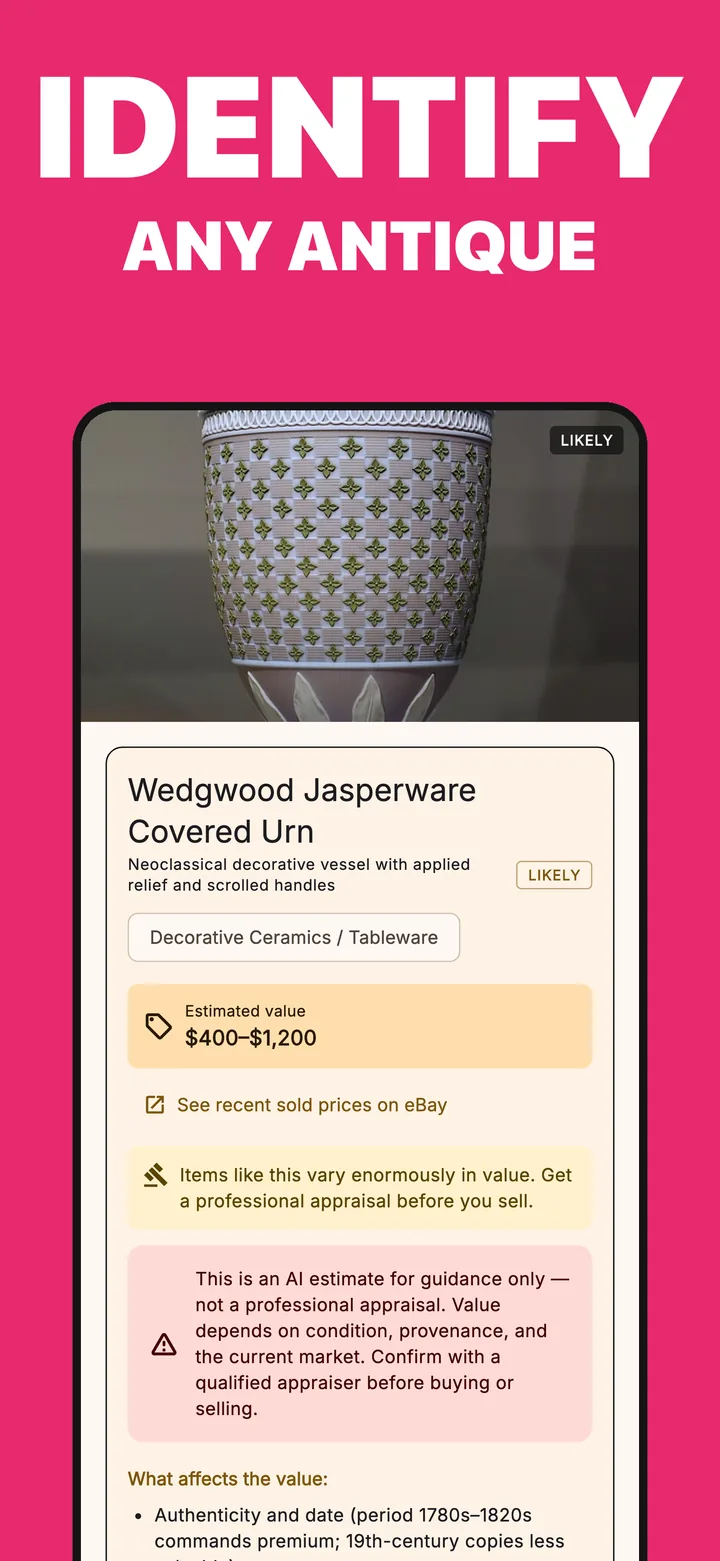
Vintio is not an appraisal, and every result says so:
This is an AI estimate for guidance only — not a professional appraisal.
What it is: a quick first pass. Vintio, an antique identifier app for iPhone, suggests what a piece likely is from your photos, with a confidence level and an estimated value range with the reasons behind it. When a piece is the kind that varies enormously in value, the result says to get a professional appraisal before you sell. That is the point where you use the rest of this guide. Get Vintio on the App Store.
Questions people ask
How much does an antique appraisal cost?
Reputable appraisers charge by the hour or a flat fee per item. A written appraisal of one item often costs a few hundred dollars. One ISA-certified appraiser publishes about $100 to $250 an hour for generalists and formal single-item reports from about $250 to $350, but that is one firm's pricing, not a survey. Ask for the fee in writing before you agree, and walk away from anyone who wants a percentage of the value.
What's the difference between an appraisal and a valuation or estimate?
An estimate is an informed opinion of what something might sell for. It can come from sold listings, an app, a dealer or an auction house. An appraisal is a written report by a qualified appraiser that states its purpose, the type of value (such as fair market value or replacement value) and how the appraiser reached it. Insurers, estates and the IRS need the second kind.
Do I need an appraisal for inherited items?
Not for everything. You may need one if the estate must report values, if heirs are dividing valuable items and want a fair split, or if a single piece looks valuable. For ordinary household contents, sold prices and a free auction estimate are usually enough to decide what to keep, sell or donate. Ask the estate's lawyer or accountant what the paperwork requires.
Are online appraisals legitimate?
Some are, but check what you are getting. A quick opinion from photos is an estimate, however it is labelled. If you need a document for insurance, an estate or a donation, ask the appraiser the same questions you would ask in person: which association they belong to, whether the report follows USPAP, and what the flat or hourly fee is. A fee based on a percentage of the value is a red flag either way.
Can an app replace an appraiser?
No. An app, including Vintio, gives an estimate: a useful first pass that can tell you what a piece likely is and whether it is worth a closer look. It is not a signed report from a qualified person who has examined the object, and it is not the document an insurer or the IRS asks for.
Updated September 25, 2026. Fee figures are one appraiser's published rates, not a survey; Antiques Roadshow details are from PBS's 2026 tour page. This guide is general information, not legal or tax advice.

Start with an estimate. Pay for an appraisal when it counts.
Vintio gives an estimated value range with its reasons and a confidence level, and tells you plainly when a piece needs a professional before you sell.

On a computer?Scan to get it on your iPhone.
Free to download · 3 free identifications · Pro is $4.99/week with a 3-day free trial, or $39.99/year · iPhone, iOS 15+