How to Tell If an Antique Is a Reproduction
You are standing at an estate-sale table with cash in your hand, or you already paid and something feels off. Here are 12 signs to check, what each one can and cannot tell you, and when to hand the question to a specialist.
To tell if an antique is a reproduction, look at several kinds of evidence together: where the wear sits, how the piece was made (joinery, saw marks, screws), the maker's mark and how it was applied, and the weight, glaze or finish. One odd sign only raises questions. A reproduction becomes more likely as more of these signs disagree with the age the piece claims.
First, what a reproduction is (and is not)
A reproduction is a later copy of an older style or object. Plenty were made honestly, as decorative pieces, museum-shop copies or revivals, and many are well made and pleasant to own. A reproduction becomes a problem only when someone sells it as the original. So the question at the sale table is not "is this a crime?" It is "does the price match what this actually is?"
There are also degrees in between. Antique Trader puts it well: "there may be degrees of fakery." A genuine old chest can have new handles. A table can be a marriage, where the top of one piece is joined to the base of another. A plate can be old with a later decoration. Keep all of those possibilities open as you go through the list.
Signs 1–2: any material
1. Wear in the wrong places
Real wear follows use. On furniture it sits where hands and feet touch: chair arms, drawer edges, the front stretcher where people rest their shoes. On a bowl or vase it sits on the foot, where the piece has slid across tables for decades. Wear on a surface nobody would touch, or no wear at all where everyone would, raises questions.
2. Ageing that looks applied
Artificial ageing tends to be too uniform. Real wear is uneven: heavier on one side, lighter on the other, with scratches running in different directions. Distressing done in a workshop often looks evenly spread, like a pattern. Dark "grime" that sits in places a cloth could never reach, but not in the corners where dirt really collects, is worth a second look.
Signs 3–6: furniture
Pull out a drawer and turn it over. Most of the evidence on furniture is on the parts nobody was meant to see.
3. Dovetails and joinery
Hand-cut dovetails are slightly uneven: the pins are often narrower than the tails, the spacing varies, and you may see scribe lines and small saw overcuts. Machine-cut dovetails are identical and evenly spaced. Machine-cut joints generally point to the late 1800s or later. The reverse does not hold: hand-cut dovetails do not prove age. Reproduction makers and craftsmen still cut them by hand, and some European makers kept hand-cutting into the 1930s. Our guide to antique furniture goes deeper.
4. Saw and tool marks
Look at the back panel, drawer bottoms and the hidden secondary wood. Straight, slightly uneven, slanted marks come from hand saws or older up-and-down saws. Curved arcs come from a circular saw, which usually means mid-1800s or later. Slight parallel ridges on undersides can mean hand planing. A piece in an 18th-century style with circular-saw arcs all over the back raises a question. Rural shops used older methods for longer, so treat this as a range, not a date.
5. Screws, hardware and extra holes
Older handmade screws have blunt ends, uneven threads and often an off-center slot. Pointed machine screws became common from about the mid-1840s–1850s. A Phillips-head screw is never antique. But screws and handles are replaced all the time, so check that the screw hole and the wood around it look the same age as the screw. Filled or extra holes behind a handle usually mean the hardware has been changed. That is common on genuine pieces and lowers value without making it a reproduction.
6. Shrinkage, wood and finish
Wood keeps moving for a very long time. An old round tabletop often measures slightly out of round across the grain, and panels and drawer bottoms may have shrunk in their grooves. New wood tends to be true and even. On finish: old shellac and oil finishes wear through, while nitrocellulose lacquer (it mostly replaced shellac in the 1920s–30s) tends to chip. Neither proves anything alone. Restorers still use shellac, and many real antiques have been refinished. Also look for cheaper wood stained to look like mahogany, or printed wood grain where you expected real veneer.
Signs 7–10: pottery and porcelain
7. The mark itself
Marks are copied. A mark that looks too crisp for its supposed age, sits in an odd position, or looks like stamp-pad ink on top of the glaze rather than fired under it, raises questions. Nippon is the classic warning: Japanese exports were marked "Nippon" from about 1891 to 1921, but fake Nippon marks have been widespread since about the 1960s–70s. A real-looking mark on a doubtful piece is still a doubtful piece. If you want to read the mark properly first, see how to identify pottery marks on the bottom.
8. Glaze, paint and gilding
Look at quality, not just style. The Nippon Collectors Club describes gold on fake pieces as "brassy and almost harsh," with poorer porcelain and painting, and the hard techniques rarely attempted. Hand-painted work shows small irregularities in the brushwork. Fine crackle in the glaze (crazing) is often read as a sign of age, but on its own it tells you little either way.
9. Weight, body and texture
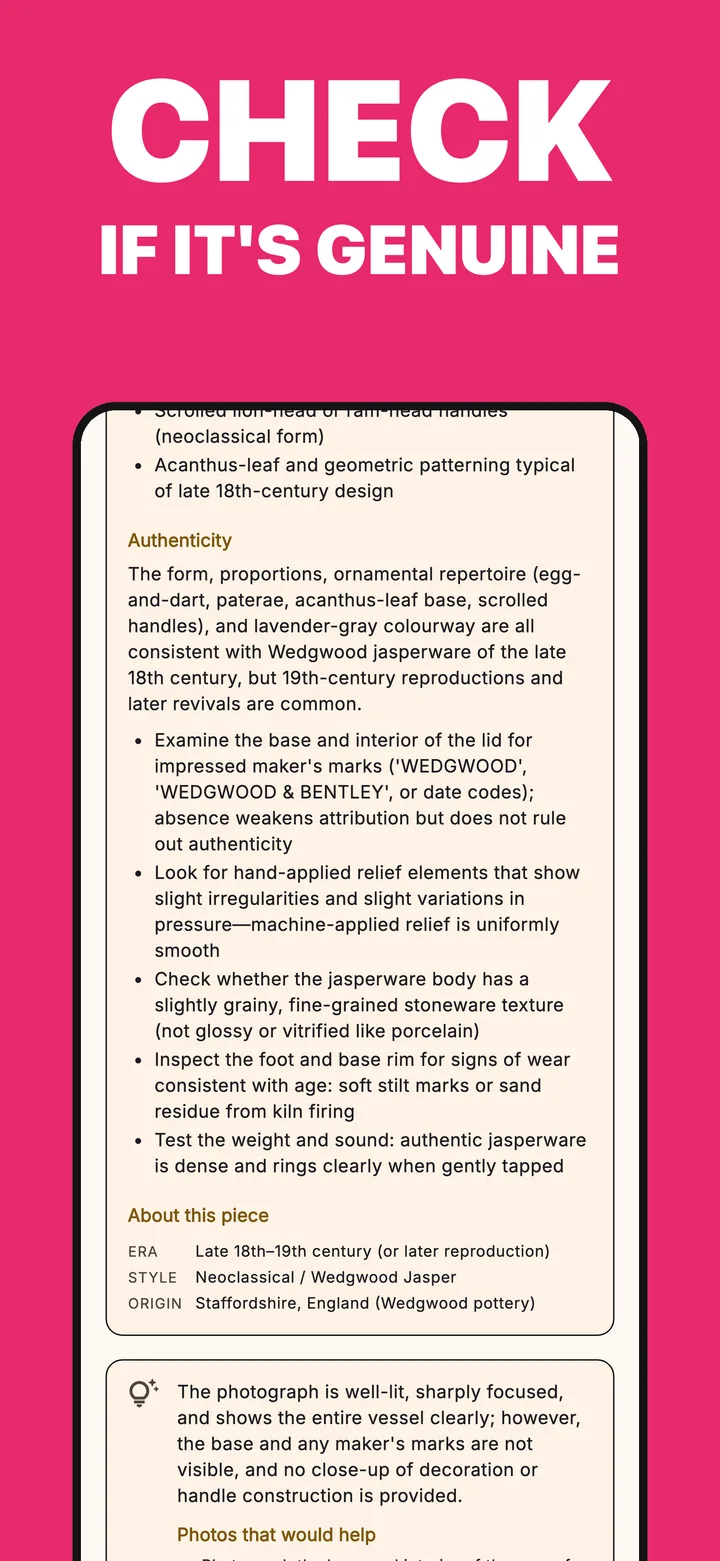
Pick it up. Compare its weight and the feel of the body with a piece you know is right, or with a dealer's description of the ware. Wedgwood jasperware, for example, has a fine, slightly grainy stoneware feel, not the glassy look of porcelain. A body that feels wrong for its type is a reason to slow down.
10. The foot rim
Turn it over and run a finger around the unglazed foot. Decades of sliding leave soft, uneven wear, sometimes with grime worked into it. A foot ring that looks too smooth and too white, or is scuffed evenly all the way round as if on sandpaper, is worth questioning.
Signs 11–12: glass and metal
11. Glass: seams, pontils and colors
On mouth-blown bottles the mold seam usually stops below the lip, while machine-made bottles (from 1889 onward) often have seams running up through the lip. The Society for Historical Archaeology warns that dating by seam height is "vastly more complicated" than that rule of thumb, so use it as a pointer only. A pontil mark on the base looks convincing, but pontils can be molded or faked. And check the color: Kovels flags colors that were never made in a given pattern as a red flag.
12. Metal: casting and marks
On cast brass, bronze or iron, compare the sharpness of detail with a documented example. Detail that looks softer than a documented example can be worth showing a specialist. On silver, forged or transposed hallmarks exist, and silver plate is sometimes sold as sterling. A mark means little unless the style, wear and construction agree with it. Our sterling or silver plate guide explains the marks.
Why no single sign settles it
Every sign above has an honest exception. Hand-cut joints are still made today. Genuine pieces get new screws, new finishes and new handles. Marks can be faked, and Invaluable notes that even a famous maker like Chelsea "was somewhat inconsistent in their use of marks." So the useful question is whether the signs agree with each other. A chest where the dovetails, saw marks, screws, shrinkage and wear all tell the same story is on solid ground. A chest where they tell three different stories needs a closer look.
Kovels advises checking condition before cleaning: "Removing an aged surface can affect its appearance and potentially its value." Grime and wear are part of the evidence.
When to ask a specialist
Ask a specialist dealer, an auction-house department or a qualified appraiser when the price is more than you would be comfortable losing, when the signs disagree, or when you plan to sell something as antique. Bring clear photos of the whole piece, the mark and the construction. Our guide to antique appraisals covers what that costs and who to ask.
Vintio is an antique identifier app for iPhone. Photograph the whole piece, then the mark and a close-up of the construction or wear. It tells you what the piece likely is, a rough era and origin, and an estimated value range. It also lists the signs to check for that particular piece: which mark to look for, what the relief or joinery should look like, where wear should be. It never stamps "real" or "fake". You look at the evidence and decide, and it tells you plainly when a piece needs a professional appraisal before you sell.
Get Vintio on your iPhone · 3 free identifications to start.
Frequently asked questions
How can you tell if an antique is real?
Look for several signs that agree: natural, uneven wear where the piece was handled; construction that fits the claimed age (joinery, saw marks, screws); a mark that is applied the way the maker applied it; and weight, body and finish that fit the type. No single sign proves it. For anything valuable, ask a specialist or qualified appraiser.
What are the most commonly reproduced antiques?
There is no reliable count, but the sources we checked flag the same areas again and again: Nippon-marked porcelain (fake marks are widespread), period-style furniture and married pieces, old bottles and pressed glass, prints sold as originals, and silver with forged or transposed marks. Anything popular with collectors is worth copying, so expect copies wherever prices are high.
Are reproductions worth anything?
Often, yes. A well-made reproduction can sell as decor, and some older reproductions have collectors of their own. They are usually worth much less than the original they copy, so the risk is paying an original's price for one. Check sold prices for the reproduction specifically, not for the original.
Can a mark be faked?
Yes. Pottery backstamps, Nippon marks and silver hallmarks have all been copied. Signs to check include ink sitting on top of the glaze instead of under it, a mark that looks too crisp for its age, or a mark in an unusual position. A mark only counts when the rest of the piece agrees with it.
Updated September 25, 2026. Dates and signs come from dealer, museum and collector-society sources, and they are rules of thumb, not proof. Vintio gives AI estimates for guidance, not professional appraisals.

Before you pay, get a list of what to check
Photograph the piece, its mark and one close-up. Vintio names what it likely is, gives an estimated value range with its reasons, and lists the signs to check on that exact piece. You judge the evidence.

On a computer?Scan to get it on your iPhone.
Free to download · 3 free identifications · Pro is $4.99/week with a 3-day free trial, or $39.99/year · iPhone, iOS 15+