How to tell if furniture is antique: pull out a drawer
The top of a dresser shows you the style. The drawer shows you how it was made. Here are the clues to check, in order, and what each one can and cannot prove.
To tell if furniture is antique, pull out a drawer and look at how it was made. Hand-cut dovetails, straight saw marks, blunt hand-made screws and shrinkage across the grain point older. Identical machine-cut dovetails, curved circular-saw marks, pointed screws and plywood point newer. No single clue dates a piece, and hardware and screws are often replaced, so trust a date only when several clues agree.
Why start with a drawer
You are standing in front of a chest of drawers at an estate sale, or in your aunt's spare room. The top has a nice color and the style looks old. That tells you less than you think. Styles get copied for generations, and a good finish can be a year old.
The drawer is different. Its sides, back and bottom were never meant to be seen, so makers did not hide how they worked. The joints, the saw marks and the screws in there are a record of the tools in the shop. Those tools changed over the 1800s, and that is what lets you put a piece in a rough time bracket.
Before you start, one rule: no single clue dates a piece. Woodworking author Bob Flexner calls dating furniture "a fine art." You are looking for several clues that point the same way.
Eight clues, in the order to check them
This order takes about five minutes and needs nothing more than a phone flashlight. If the owner lets you, take one drawer fully out.
- Look at the dovetails
Pull a drawer all the way out and look at the corner where the front meets the side. Hand-cut dovetails are a little uneven: the spacing wanders, the narrow pins are often much thinner than the tails, and you may see a faint scribe line or a small saw overcut where the maker marked and cut by eye. Every drawer is slightly different. Machine-cut dovetails are identical and evenly spaced, drawer after drawer. A row of round pegs sitting in scalloped cutouts is the pin-and-scallop (Knapp) joint, an American machine joint used from about the early 1870s to about 1900. Machine-cut dovetails generally point to the late 1800s or later.
- Turn the drawer over and read the saw marks
Drawer bottoms and backboards were hidden, so nobody bothered to smooth away the tool marks. Straight, uneven, slightly slanted marks come from a pit saw or an up-and-down saw. Curved arcs come from a circular saw, and usually mean the mid-1800s or later. Faint parallel ridges and hollows from a hand plane are an older sign too. Rural shops kept older methods longer than city factories, so treat this as a range, not a date.
- Check the screws and nails
Lift out a screw you can reach without damage, or look closely at the head. Older hand-made screws have a blunt end, file marks, uneven threads and often an off-centre slot. Pointed machine screws with even threads and a centred slot became common from about the mid-1840s to the 1850s. A Phillips (cross-head) screw means that screw is not antique. Screws and nails are easy to replace, so check that the hole and the wood around it look the same age as the screw.
- Look for wood movement and the way it was cut
Wood shrinks across the grain over many decades. Measure a round tabletop both ways: an old one is often slightly out of round across the grain. Panels and drawer bottoms may have shrunk in their grooves, leaving a gap. Check the veneer at a chipped edge: thick, hand-sawn veneer (roughly 1/16 to 1/8 inch in 17th- and 18th-century work) is an older sign, and very thin veneer (about 1/32 inch) is Victorian or later. Shrinkage shows age, but it can be missing in a stable climate, and it can be faked.
- Check the secondary woods
Secondary woods are the ones you are not meant to see: drawer sides, backs, bottoms and dust boards. They should match each other from drawer to drawer. One drawer with different wood or different joints suggests a replacement. Plywood in a drawer bottom or back points to the 20th century: three-ply as we know it dates from about 1905 and was widely available before 1920.
- Look behind the hardware
Pulls, knobs and escutcheons are the parts most often replaced. Look at the inside of the drawer front. Extra holes, filled holes or a shadow of a different-shaped pull mean the hardware has changed at least once. Replaced hardware does not make a piece new. It only means the pulls cannot date it.
- Read the finish
Shellac and French polish were used from the late 1700s, and by Victorian times most furniture had a shellac finish of some sort. Nitrocellulose lacquer mostly replaced shellac in the 1920s and 1930s, and polyurethane came later. Old shellac and oil finishes wear through at the edges; lacquer tends to chip. Restorers still use shellac today, so a shellac finish does not prove age.
- Follow the wear
Real wear sits where hands and feet touch: the arms of a chair, the front edges of drawers, the stretchers people rest their feet on, the bottom of the feet. It is uneven and it makes sense. Wear that is equally heavy everywhere, or on places nobody touches, is worth a second look.
The clues at a glance
Keep this open on your phone while you look. The last column matters most: it is why one clue alone can mislead you.
| Clue | Older sign | Newer sign | The catch |
|---|---|---|---|
| Dovetails | Hand-cut, uneven, thin pins, scribe lines | Machine-cut, identical; generally late 1800s or later | Hand-cut joints were still made later, by craftsmen and reproduction makers |
| Saw marks | Straight, uneven, slanted | Curved arcs from a circular saw; usually mid-1800s or later | Country shops used old methods for longer |
| Screws | Blunt end, uneven threads, off-centre slot | Pointed tip, even threads; common from about the mid-1840s–1850s | Screws are often replaced |
| Wood movement | Round tops out of round, panels shrunk in grooves | True, even surfaces | Can be missing in a stable climate, or faked |
| Veneer and panels | Thick, hand-sawn veneer | Thin veneer; plywood (about 1905 onward) | Old pieces get new backs and drawer bottoms |
| Hardware | Matches the style, no extra holes | Extra or filled holes behind the pulls | Changed hardware says nothing about the case |
| Finish | Shellac or oil that wears through | Lacquer that chips (1920s–30s onward); polyurethane | Shellac is still used; many antiques are refinished |
| Wear | Uneven, where hands and feet touch | Little wear, or wear everywhere at once | Wear can be faked |
Dates are rough ranges. Sources disagree on when each change started, so read them as "usually", never as a cut-off year.
What reproductions get right, and wrong
A good reproduction copies the style perfectly, because that is the easy part. The trouble is that people then test it with the one clue they have heard about.
The most common mistake is: "It has hand-cut dovetails, so it's antique." Not necessarily. European makers kept cutting dovetails by hand into the 1930s, and craftsmen and reproduction workshops still cut them by hand today. Hand-cut dovetails tell you the piece could be old. The saw marks, screws, secondary woods and wear have to agree.
A piece can also be partly old. Antique Trader notes that "there may be degrees of fakery." Things to look for:
- Marriages: a top from one piece on a base from another. Check that the wood, color and construction of the two halves match, including the backboards.
- Replaced parts: one drawer, the feet or the back made later. Compare every drawer, not only the top one.
- Added decoration: carving or inlay added later to a plain piece to make it more desirable.
- Disguised wood: cheaper wood stained to look like mahogany, or printed wood grain and paper veneer on newer factory furniture.
None of these is a verdict. They are signs to check. If a lot of money depends on the answer, a furniture specialist or a qualified appraiser should see the piece in person. Our guide to telling an antique from a reproduction covers the same thinking for pottery, glass and metal.
Refinishing and value
If there is one thing to hold back on, it is the sander. An old surface, with its wear and color, is part of what collectors pay for on many pieces. Kovels puts it carefully: removing an aged surface "can affect its appearance and potentially its value."
That does not mean every refinished piece is worthless, or that every original finish is precious. Plenty of everyday antique furniture sells mainly as good, solid furniture, and a sound refinish may not change its price much. Kovels also points out that rarity and demand matter more than age alone.
So: clean gently if you must, but do not strip, sand or refinish until you know what you have. For a first idea of price, check what similar pieces actually sold for. Our guide on checking eBay sold prices shows how.
What to photograph
Whether you are sending photos to a relative, a dealer or an app, the same shots answer most questions:
- The whole piece, front on, in soft daylight, with no flash glare.
- The drawer joint, close and sharp. This is your detail shot, and for furniture it is the most useful one.
- Any label, stamp or maker's mark, often inside a drawer, on the back or under the top. This is your mark shot. Even a torn paper label can help.
- If you can, the back panel, the underside, and a close-up of the hardware and any damage.
Our full guide to photographing antiques covers light, focus and scale.
Vintio is an antique identifier app for iPhone. Furniture works the same way as a vase or a clock: three photos. Take the whole piece, then the drawer joint as the detail shot, then any label or stamp as the mark shot. Add a note if you know something, such as "from my grandmother's farmhouse in Ohio."
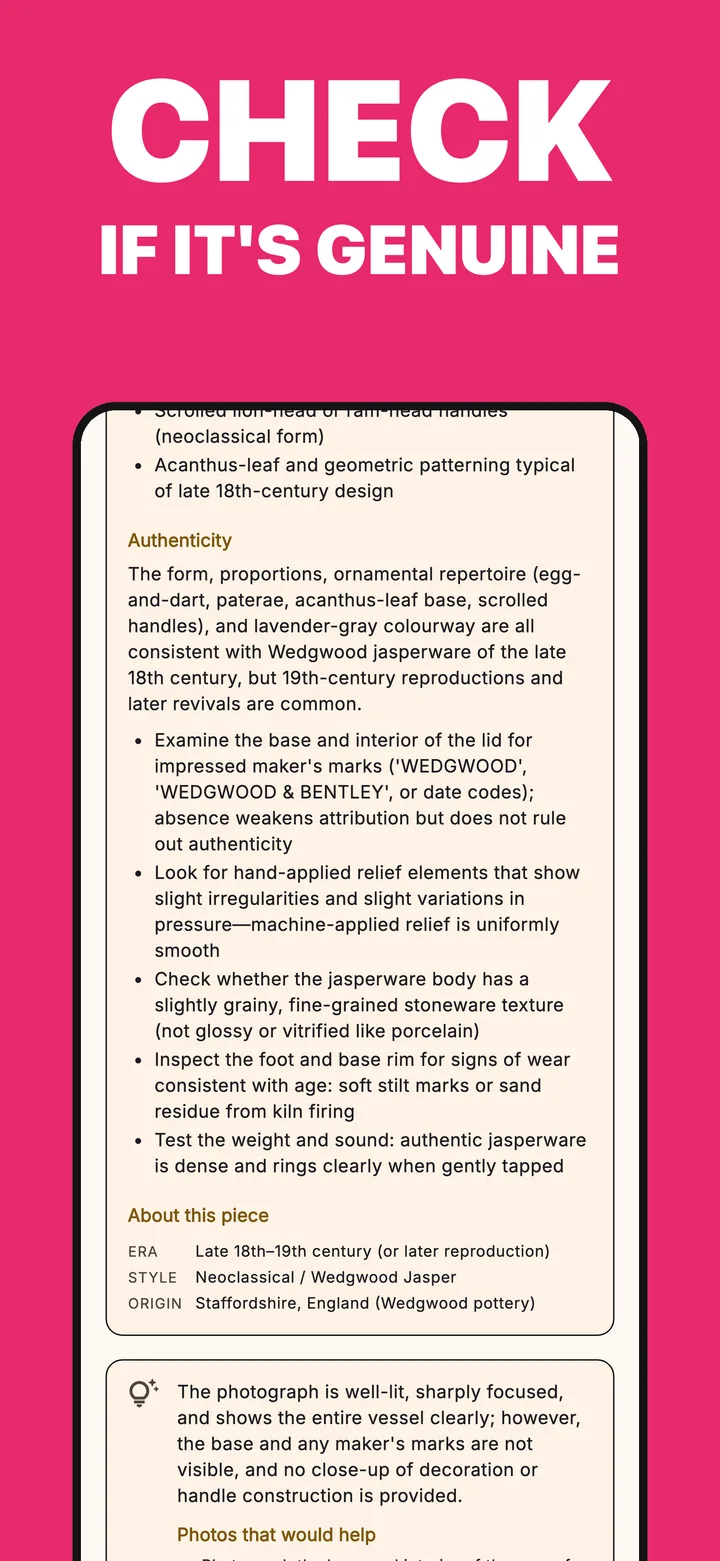
You get a likely era, style and origin with a confidence level, an estimated value range with the reasons behind it, and signs to check on the piece in front of you. It does not declare a piece antique or reproduction. It gives you the evidence to weigh, and says when a professional should look. Get Vintio on the App Store.
Questions people ask
How can you tell hand-cut dovetails?
Compare two or three drawers. Hand-cut dovetails vary: the spacing is a little uneven, the pins are often much narrower than the tails, and you can sometimes see a scribe line or a small saw overcut past the joint. Machine-cut dovetails are identical on every drawer. Remember that hand-cut dovetails do not prove age on their own, because some makers still cut them by hand.
What year did machine-cut dovetails start?
There is no single agreed year. Some guides say about 1860. The Knapp machine was patented in 1867 and first used in a factory in 1871. Woodworking author Bob Flexner says machine-cut dovetails mean a piece is no older than about 1895, and one dealer puts the switch in the US after the late 1890s. The honest summary is that machine-cut dovetails generally point to the late 1800s or later.
How do screws help date furniture?
Older hand-made screws have blunt ends, uneven threads and often an off-centre slot. Pointed machine screws became common from about the mid-1840s to the 1850s; a museum conservation study found claims for their start ranging from 1834 to 1849. Screws are often replaced, so check that the hole and the wood around it match the screw's age before you trust it.
Does refinishing lower the value?
Often it can, especially on early or high-quality pieces, where collectors care about the original surface. Kovels warns that removing an aged surface can affect a piece's appearance and potentially its value. On everyday furniture the difference may be small. Do not strip or refinish anything before you know what it is.
Updated September 25, 2026. Dating ranges follow published woodworking, conservation and dealer sources, which do not all agree; we give the range, not a single year. Vintio gives AI estimates for guidance, not professional appraisals.

Drawer out? Take three photos.
The whole piece, the dovetail joint, and any label or stamp. Vintio gives a likely era, style and origin, an estimated value range with its reasons, and how sure it is.

On a computer?Scan to get it on your iPhone.
Free to download · 3 free identifications · Pro is $4.99/week with a 3-day free trial, or $39.99/year · iPhone, iOS 15+