Is Your Grandmother's China Worth Anything?
The hutch is full, the holidays it was bought for are memories now, and someone in the family has asked, "Should we just sell it?" Here is the honest answer, and a way to check your own set in an afternoon.
Is your grandmother's china worth anything? Often less than the family hopes. Plenty of full dinner sets are on the market and fewer people set formal tables, so many sets sell for modest sums. But some makers and patterns, hand-painted pieces and serving pieces still find buyers. To check yours, turn a plate over, read the backstamp, and search that pattern on eBay with the Sold items filter on.
The honest answer, gently
Your grandmother's china mattered because of the dinners it served, and nothing on this page changes that. But if the question is money, it helps to go in with realistic expectations.
Fine china was a standard wedding gift for generations, which means a lot of it was made and a lot of it survived, carefully wrapped in hutches and basements. Now many of those sets are coming out of houses at the same time, while fewer households host the kind of formal dinner they were bought for. Lots of supply, fewer buyers. So a complete service for twelve can sell for far less than it cost new, and some sets are hard to sell at all.
That's the general picture, not a verdict on your set. Some china still sells well: pieces from sought-after makers, certain patterns collectors hunt for, older hand-painted porcelain, and serving pieces that people need to complete their own sets. The only way to know which group yours is in is to look at the mark and at what the same pattern has actually sold for.
If you and your siblings are deciding together, agree on the facts first (maker, pattern, condition, recent sold prices) before anyone argues about what to do with it.
Start by turning a plate over
Pick a dinner plate, the one in best condition, and turn it over. Most china has a printed mark on the back called a backstamp. Look for three things:
- The maker's name or logo. Often with a crown, a wreath, a shield or initials.
- The pattern name. Many 20th-century sets print it right under the maker's mark, sometimes with a pattern number. This is the single most useful thing to write down.
- A country of origin. "England," "Bavaria," "Japan," "Made in USA" and so on. It helps with rough dating (more on that below).
Photograph the backstamp straight on, in daylight, with the flash off, so you can zoom in and read it later. If the stamp is faint, our guide to photographing antiques covers how to light a mark so it reads. Check a cup, a saucer and a serving platter too: marks sometimes differ between pieces, which can tell you the set was assembled over time.
No pattern name? Search the maker plus a short description of the design ("maker name white with gold rim and pink roses"), and compare pictures. Replacement-matching services, which sell individual pieces to people completing a set, often have large pattern image libraries that help here.
What "Nippon," "Occupied Japan" and "England" can tell you
Country names on the back are a rough dating clue, not proof. A few you'll see often in inherited cabinets:
- Any country name (for example "England" or "Bavaria") usually suggests the piece was made after about 1891, when a US tariff law started requiring imports to show their country of origin. But some firms marked their wares before then, and no country name does not prove a piece is older.
- "Made in England" generally points to the 20th century, roughly the early 1900s onward. Sources disagree on exactly when it became common, so treat it as a broad guide.
- "Nippon" was used on Japanese exports from about 1891 to 1921, after which "Japan" replaced it. Be careful: fake Nippon marks are common, and have been for decades.
- "Occupied Japan" or "Made in Occupied Japan" points to roughly 1947 to 1952. Not everything made in that period carries it.
- "Japan" alone covers a very wide span of dates and quality, from inexpensive souvenir ware to fine porcelain dinner services. The maker and pattern matter far more than the word.
For the fuller picture, including registration marks and what to do when there's no mark at all, see how to read pottery marks on the bottom.
Check sold prices, not asking prices
Here is where most people get misled. Search a pattern on eBay and you'll see some sets listed at eye-catching prices. Those are asking prices: what sellers hope for. Some of those listings have sat there for months.
What you want is what buyers actually paid:
- Search eBay for the maker and pattern name.
- Turn on the Sold items filter (on the website it's under "Show only" in the left column; in the app, under Filter). Sold prices show in green.
- Compare several sales of the same piece type in similar condition. A single dinner plate, a teacup and saucer, a platter and a full set all sell differently.
Two caveats. Normal eBay search shows only about the last 90 days of sales. And when a seller accepts a Best Offer, the green price can show the original list price rather than what the item really sold for, so look at the middle of several sales, not the highest. Our guide to checking eBay sold prices goes step by step.
For older or finer porcelain, LiveAuctioneers publishes free auction price results going back to 1999 (you need a free account). Auction results include unsold lots, and a big-city sale doesn't always translate to a local one, but they're a useful second view.
A five-minute condition check
Condition moves china prices more than people expect. Hold each piece up to a window and look for:
- Chips and cracks. Run a fingertip around rims and the foot ring. Tap a plate gently with a fingernail: a dull thud rather than a clear ring can mean a hidden crack.
- Crazing. A fine web of lines in the glaze. Common with age; heavy crazing or staining in the lines lowers value.
- Worn gilt. Gold rims and bands rub off with use. A bright, complete gold line is better than a patchy one.
- Dishwasher fade. A cloudy, dull glaze and faded pattern, often with gold worn nearly away. It rarely comes back.
- Utensil marks. Gray scratches across the center of dinner plates from knives and forks.
Don't scrub or bleach pieces before you've looked. Photograph them as they are.
What tends to make china sell
| Factor | Why it matters | What to look for |
|---|---|---|
| Maker | Well-known makers have collectors and a steady market for replacements. | A clear backstamp with a maker's name. |
| Pattern | Some patterns are hunted; others are everywhere. | Pattern name, then sold results for that exact pattern. |
| Hand painting | Hand-painted decoration usually beats printed transfer patterns. | Visible brushstrokes, slight variation between pieces, a painter's signature. |
| Serving pieces | People completing a set need the tureen or platter far more than a thirteenth dinner plate. | Tureens, gravy boats, platters, covered dishes, teapots. |
| Completeness and condition | A matched, undamaged run of pieces is easier to sell. | No chips, bright gilt, no dishwasher fade. |
General tendencies, not rules. Always check sold results for your own pattern.
Sell, donate or keep: your options
- Sell the best pieces on their own. Serving pieces and teacups often sell more easily one at a time than a full set does.
- Replacement-matching services. Some businesses buy china to resell as replacement pieces. They choose the patterns they want and pay dealer prices, so ask for a quote before you ship anything.
- Local sale. A consignment shop, a local auction or an estate sale can move a full set without shipping breakables.
- Donate. Thrift stores and charities accept dishes, and someone setting up a first home may be glad of them.
- Keep a few. Many families keep a place setting or two for each sibling, or the one serving dish everyone remembers. That may be worth more than the rest of the set put together.
If you're working through a whole house, not just one cabinet, our guide to clearing a parent's house covers what else deserves a second look.
How Vintio helps
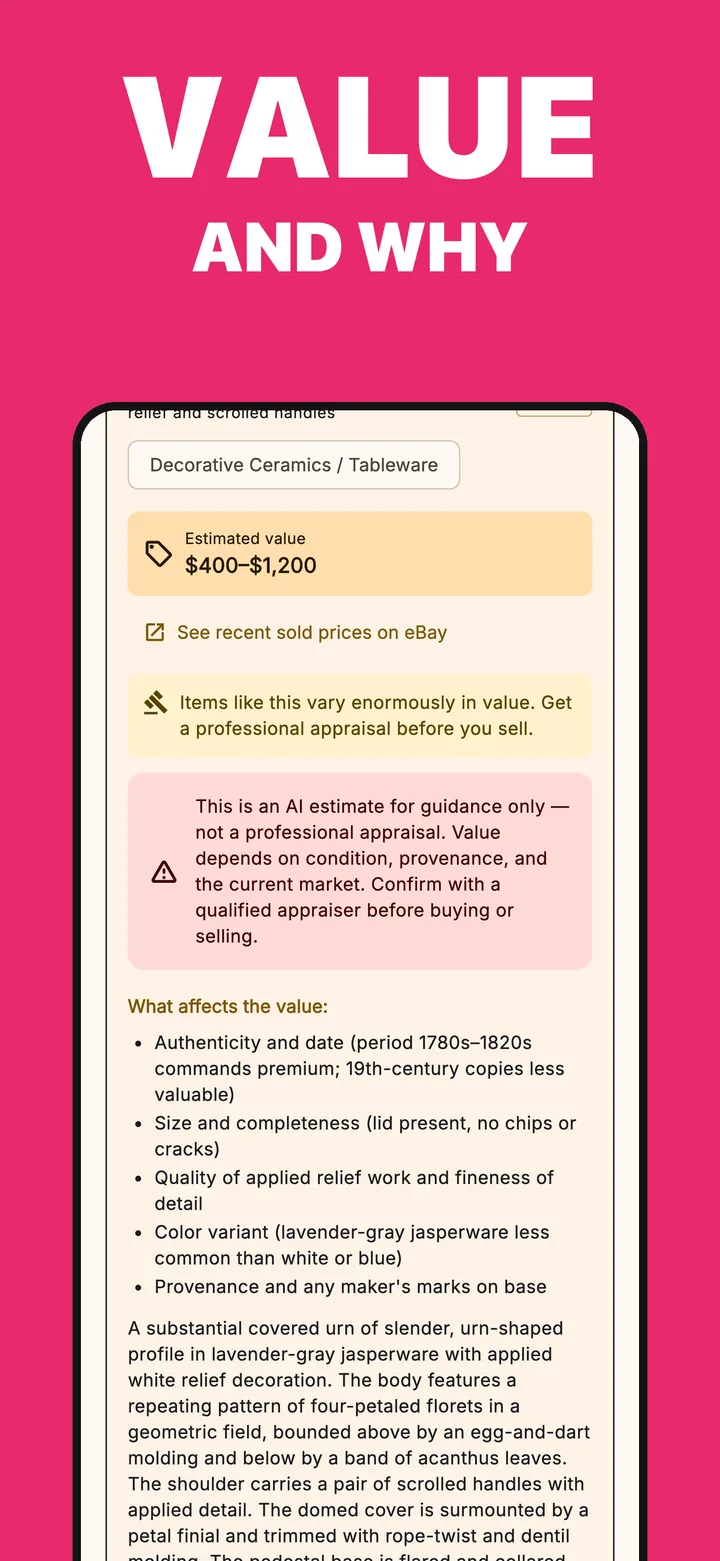
With Vintio, an antique identifier app for iPhone, you photograph the front of a plate, then the backstamp, then a detail such as the gilt or a painted flower. It gives what the china likely is, a rough era and origin, an estimated value range, and the reasons behind that range, such as maker, condition, completeness and demand. It shows how confident it is, and one tap opens a pre-filled eBay sold-listings search so you can compare what similar pieces actually sold for.
It's an AI estimate for guidance, not a professional appraisal, and it says plainly when a piece is worth taking to a professional. Download Vintio on the App Store.
Frequently asked questions
Is old china worth anything anymore?
Some is, much isn't worth as much as people hope. Many full dinner sets sell for modest sums because supply is high and fewer people buy formal china. Pieces from sought-after makers and patterns, hand-painted porcelain and serving pieces are the likeliest to sell well. Check sold prices for your exact pattern.
How do I find my china pattern?
Turn a plate over and read the backstamp. Many sets print the pattern name or number under the maker's mark. If there's no name, search the maker plus a description of the design and compare images, including on replacement-matching sites.
Is china marked "Japan" valuable?
It depends on the maker and pattern, not the word. "Japan" appears on everything from inexpensive souvenir ware to fine porcelain. "Nippon" usually means about 1891 to 1921 and "Occupied Japan" roughly 1947 to 1952, but fake Nippon marks are common, so check sold prices for your specific piece.
Where can I sell old china?
Options include eBay and other marketplaces (best for serving pieces and individual items), replacement-matching services that buy patterns they need, consignment shops, local auctions and estate sales. Ask for a quote before shipping anything, and compare it with recent sold prices.
Does gold trim make china valuable?
Not on its own. The gold on a rim is usually a very thin decorative layer, not a meaningful amount of metal. Bright, unworn gilt helps a piece sell; rubbed or dishwasher-faded gold lowers its appeal. The maker, pattern and condition matter more.
Updated September 25, 2026. Dating guidance on country marks follows collector society and museum sources, and is a guide rather than proof. Vintio gives AI estimates for guidance, not professional appraisals.

Know what's in the hutch before anyone decides.
Photograph a plate and its backstamp. Vintio shows what it likely is, an estimated range with its reasons, and a link to what similar pieces actually sold for.

On a computer?Scan to get it on your iPhone.
Free to download · 3 free identifications · Pro is $4.99/week with a 3-day free trial, or $39.99/year · iPhone, iOS 15+