How to Identify Pottery Marks on the Bottom of a Piece
You are holding a vase upside down, squinting at a stamp, a squiggle or two initials. Here is how to read what you are looking at, what it can tell you about who made it and when, and where it can lead you wrong.
To identify pottery marks on the bottom, first work out how the mark was made (pressed into the clay, printed, or painted), then read any words, country names or registration numbers, and look the mark up in a free reference such as thepotteries.org or porcelainmarksandmore.com. Treat what you find as a clue to the maker and a rough date range, not as proof. Marks were used inconsistently, and some are faked.
The kinds of marks you will find
Marks usually sit on the base: under the foot of a vase, on the back of a plate, sometimes inside the base of a figure. How a mark was applied is your first clue, because it tells you what to look up and how far to trust it.
- Impressed. Pressed into the soft clay before firing, so it is a dent, not ink. Run a fingertip over it. Glaze may have pooled in it and softened the letters.
- Incised. Scratched or cut into the clay by hand before firing. Common on studio and art pottery, often as initials or a signature.
- Printed (transfer). A printed backstamp, often a name inside a shape such as a crown, garter or shield. This was the common method on 19th-century wares, and it often names the pattern too.
- Painted. Written or painted by hand, often on porcelain, sometimes with a decorator's or artist's signature or a pattern number.
- Registry marks. A British diamond-shaped mark, or later the letters "Rd No" with a number. These record a registered design (more on them below).
- Paper labels. Foil or paper stickers, often lost over time. A surviving label is useful; a missing one tells you nothing.
How to read a mark, step by step
- Photograph it well Use soft daylight from a window and no flash, which bounces off glaze. Tap to focus on the mark, and take a second shot at a low angle so an impressed mark casts small shadows you can read.
- Note how it was made Decide whether it is impressed, incised, printed, painted or a label. Write that down with the colors and any shape around the words.
- Read the words and the country Copy out every letter exactly, even partial ones, including a country name, "Made in", "Ltd" or a pattern name.
- Check for registration marks Look for a diamond-shaped mark or "Rd No" followed by a number. Both point to a British registered design and give an earliest possible date.
- Look it up in a marks reference Search the maker's name, initials or symbol in a free reference that fits the likely origin, and compare the exact version of the mark, since makers changed their marks over time.
- Compare with sold examples Search eBay with the Sold items filter for the maker and pattern, and check that the marks, shapes and sizes in those listings match yours.
Our guide to photographing antiques covers the lighting and focus in more detail.
What the words tell you about age
These are rules of thumb that collectors and museums use. Each one gives a likely range, never a date on its own.
| What the mark says | What it suggests | The catch |
|---|---|---|
| A country name, such as "England" or "Bavaria" | Usually made after about 1891, when the US McKinley Tariff (passed October 1890) required imports to show their country of origin | Marking was inconsistent. Some firms used "England" before 1891, and a missing country name does not prove an earlier date. |
| "Made in England" | Generally 20th century, roughly the early 1900s onward | Sources disagree on when it started, and makers adopted it voluntarily. Do not read a single year into it. |
| "Nippon" | Japanese export, about 1891–1921. After 1921, "Japan" replaced "Nippon". | Fake Nippon marks are common. A Nippon mark on a poor-quality piece needs a close look. |
| "Occupied Japan" | Made roughly 1947–1952 | Not every item from those years carries it; "Japan" and "Made in Japan" were also used. |
| Diamond-shaped registry mark | A British design registered between 1842 and 1883 (two layouts: 1842–67 and 1868–83) | It dates the design's registration. The piece was made that year or later, often years later. |
| "Rd No" plus a number | A British design registered in 1884 or later; the number range points to the year | Again, the piece was made no earlier than the registration year, and often later. |
| "Ltd" or "Limited" | On pottery, mostly after about the 1880s | A loose guide only. |
Sources: porcelainmarksandmore.com, the Nippon Collectors Club, the UK National Archives and dealer guides. Where they disagree, we give the broader range.
Worked example: a jasperware urn
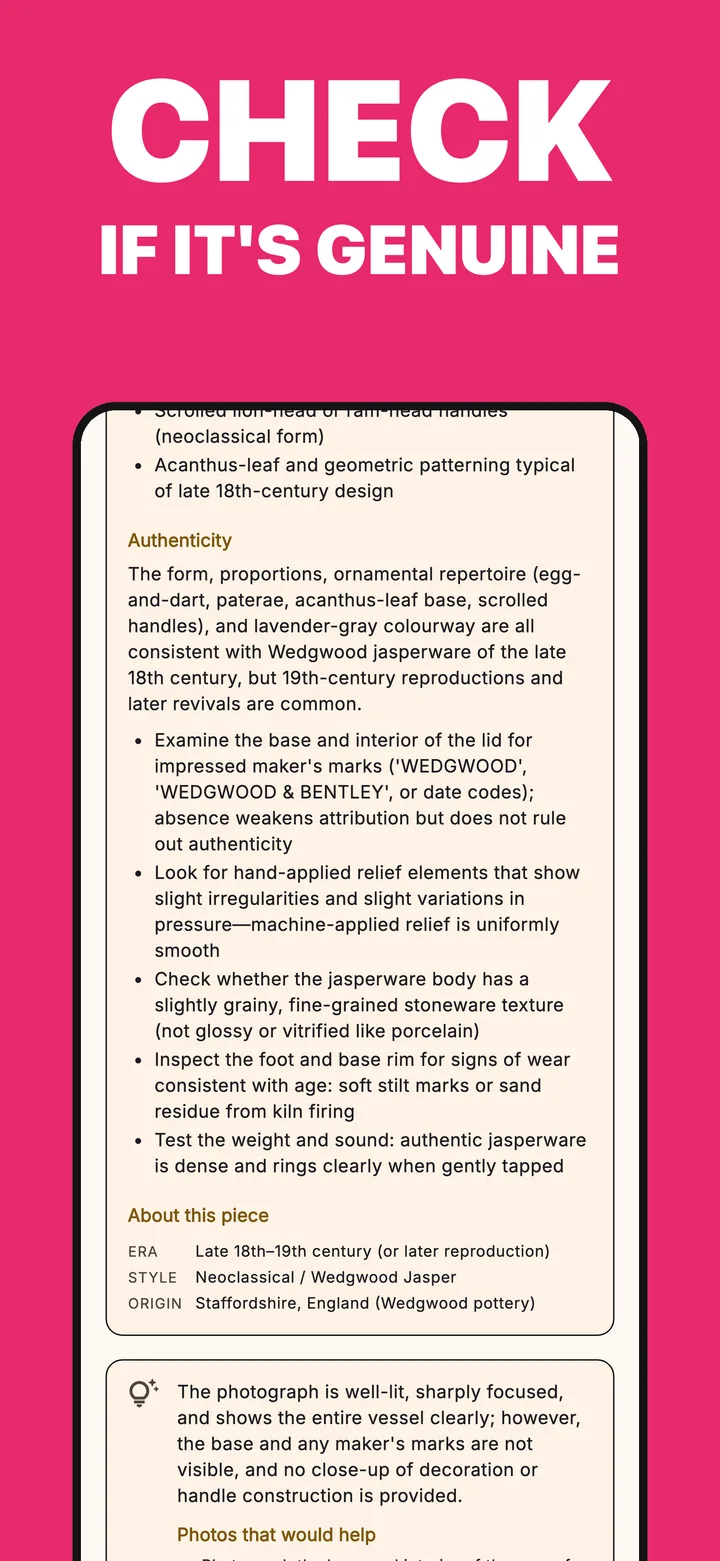
Here is how this works on a real piece. A lavender-gray urn with white relief decoration looks like Wedgwood jasperware. Style alone cannot settle it, because this look was widely copied and revived.
So you turn it over. Wedgwood impressed its name into the clay from about 1759, and used a single-stamp impressed "WEDGWOOD" from 1769. From 1860 the factory also impressed three-letter date codes. That tells you exactly what to look for: a pressed-in name, possibly with small letter codes, on the base and inside the lid. A missing mark weakens the attribution but does not rule it out. The urn also needs to agree with the mark: crisp hand-applied relief, a fine stoneware body, and natural wear on the foot rim.
Where to look marks up
Match the reference to where the piece probably came from:
- thepotteries.org (free): Staffordshire and other British potters, with dating pages for major makers.
- porcelainmarksandmore.com (free): mainly German and other European porcelain, with historical notes.
- gotheborg.com (free): Chinese and Japanese ceramics, with a glossary and Q&A.
- The Nippon Collectors Club (free): a backstamps page, plus alerts on reproduction marks.
- Kovels Marks Guide (paid): a large searchable marks database, included in a Kovels subscription.
A reverse image search of the mark with Google Lens can also help, especially for printed backstamps, but results vary on small or worn marks. Once you have a name, check what similar pieces actually sold for, not what sellers are asking. Our guide to inherited china walks through that for dinnerware.
When there is no mark
Plenty of good pottery is unmarked. Some makers marked only part of a set, some marks were on paper labels that have since fallen off. As Kovels puts it, "an unmarked object isn't necessarily worthless." Without a mark, you fall back on the piece itself: the shape, the body (earthenware, stoneware or porcelain), the glaze, the decoration, and how the foot was finished. Those clues are covered in our guide to telling if something is antique.
Why a mark alone proves nothing
A mark is a claim made by whoever applied it. Most of the time the claim is true, but not always. Even well-known factories marked inconsistently: Invaluable notes that Chelsea "was somewhat inconsistent in their use of marks." Faked marks exist too. Signs to check include ink that sits on top of the glaze instead of under it, a mark that is too crisp for its supposed age, or a mark in an unusual position. Our reproduction guide lists the other signs.
Fake Nippon backstamps, including versions of the "M in wreath", maple leaf and rising sun marks, have been produced since about the 1960s–70s. The Nippon Collectors Club notes that fakes often have brassy, harsh gold and weaker painting. Judge the piece first and the mark second.
Vintio is an antique identifier app, not a marks encyclopedia. It does not have a marks database or run text recognition on a mark. It looks at your photo of the mark together with photos of the whole piece and any close-up, and considers them as one identification. Photograph the whole vase or plate, then the base, then a detail. You get what the piece likely is, a rough era, style and origin, an estimated value range with the factors that move it, and signs to check, such as which mark to look for on the base. If it is not sure, it says so and suggests which photo would help.
Download Vintio on the App Store · 3 free identifications, iPhone only for now.
Frequently asked questions
How do I identify a pottery mark with initials?
Note exactly how the initials appear: the letters, their order, any shape around them, and whether they are impressed, printed or painted. Then search a free reference that fits the likely origin, such as thepotteries.org for British makers or porcelainmarksandmore.com for European porcelain. Initials can belong to the factory, a decorator or an individual potter, and small letter groups can also be date codes, so compare the full mark, not just the letters.
What does "Made in England" tell me about age?
It generally points to the 20th century, roughly the early 1900s onward. Sources disagree on when makers started using it, and the "Made in" wording was never required by US import rules, so do not read a single year into it.
What if my pottery has no mark?
That is common and does not mean it is worthless. Marks were sometimes left off, or put on paper labels that fell away. Look at the shape, body, glaze, decoration and foot instead, and photograph those clearly if you ask for help.
Are hand-painted marks older?
Not necessarily. Hand-painted marks are common on porcelain and were used alongside printed marks, and printed backstamps were already the common method in the 19th century. A painted mark tells you how it was marked, not when.
How do I tell if pottery is valuable?
Identify the maker and pattern first, then check condition (chips, cracks, repairs) and look up what similar pieces actually sold for, using eBay's Sold items filter or free auction archives. Maker, rarity, condition and current demand matter more than age. If it might be worth a lot, get a professional appraisal before you sell.
Updated September 25, 2026. Dating rules are rules of thumb from collector, museum and archive sources; they give ranges, not proof. Vintio gives AI estimates for guidance, not professional appraisals.

Turn it over, then take the photo
Photograph the whole piece and the mark underneath. Vintio weighs both together and gives a likely identification, a rough era and origin, an estimated value range with its reasons, and the signs to check next.

On a computer?Scan to get it on your iPhone.
Free to download · 3 free identifications · Pro is $4.99/week with a 3-day free trial, or $39.99/year · iPhone, iOS 15+